Non-Humanoid Characters
- Home
- Rig
- Advanced Rigging
- Other Topics
- Non-Humanoid Characters
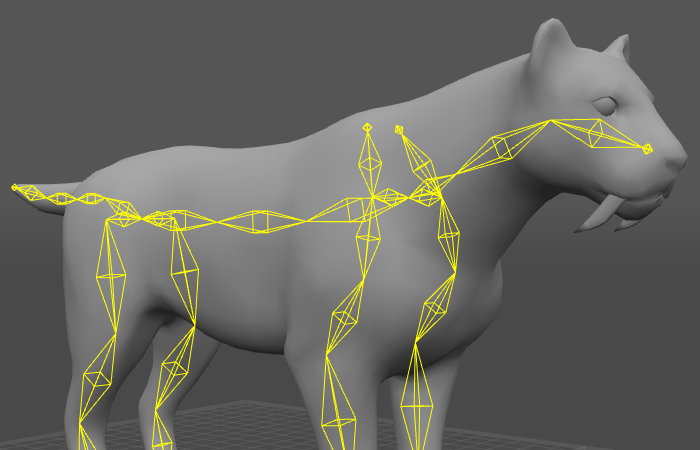
While humanoid characters are the most common kind, you might very well encounter characters that are structured differently.
This page describes how to rig such characters.
Most non-humanoid characters follow the basic quadruped structure - spine, four limbs, tail. This means that you can use the Quick Rigging Tool to rig them.
1. Enable the Rigging mode.
2. Switch to the Quick Rigging Tool.
3. There, switch to the Quadruped preset:
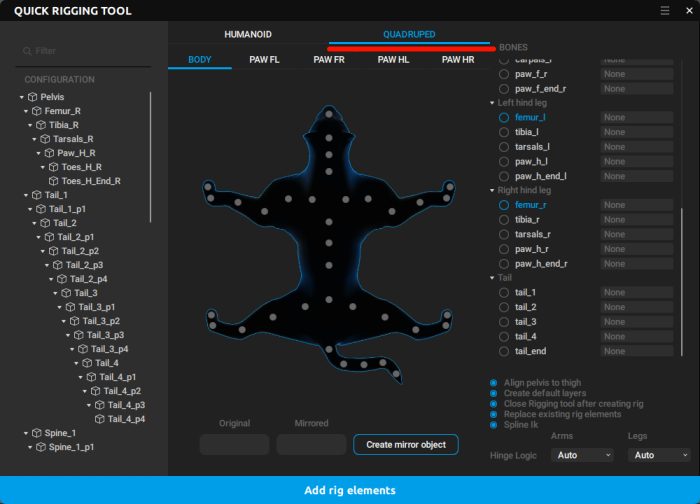
On this panel, you’ll need to set Joints (shown as a list at the left side) to their respective slots (shown as the points on the silhouette - and also as a list at the right side).
Sometimes, there might be more Joints than there are slots for them, like in this example:
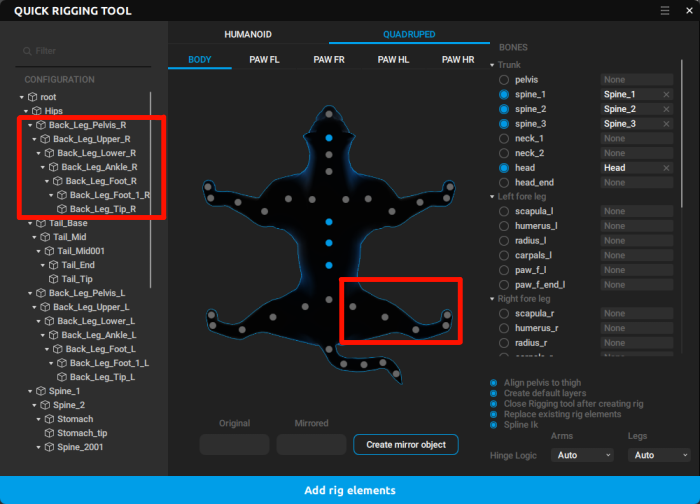
There are seven Joints in the right hind leg, but only five slots.
You’ll need to rig some joints while ignoring others.
Depending on what joint you choose, the body part will bend differently. So a decision should be based on which bending point you find more useful for the kind of animation you’re planning to create.
Other times, there might be no Joints corresponding to a specific slot, like here:
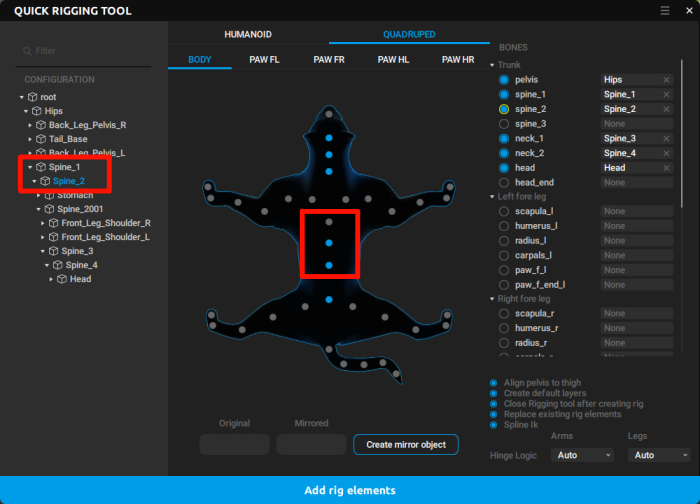
Here, we have three slots for the spine, but only two Joints associated with the body part (Spine_3 and Spine_4 are in the character’s neck).
In cases like these you can simply ignore those slots.
However, doing so will prevent you from using AutoPosing. But if you don’t plan to use it, this can be a valid solution.
if you do plan to use AutoPosing, you can create additional joints yourself.
They don’t have to correspond to any part of the mesh.
After you set Joints to their slots, the basics of the rig should be set. But this doesn’t mean the work is over - there still might be room for adjustments.
For Small Parts
For parts like ears, jaws etc, you should use Box controllers to rig them.
See here to learn about this.
Center of Mass
In animals, the center of mass is often placed closer to the shoulders that to the center of the body.
Its position is defined by the masses of the Rigid Bodies; so to adjust its position, you’ll need to adjust these masses.
You don’t need exact masses, only a correct distribution. simply change the masses and see what happens - until the center of mass is where you need it.
Rigid Bodies
You can also adjust the sizes of the Rigid Bodies. A good practice is to make them more or less in line with the sizes of the body parts they’re attached to - although you don’t need to be 100% precise.
For the same reason, you might sometimes to change their placement - relative to the rig elements.
Mirroring
Animation characters are often symmetrical. This means we can use the Mirror option and only rig one side of the character.
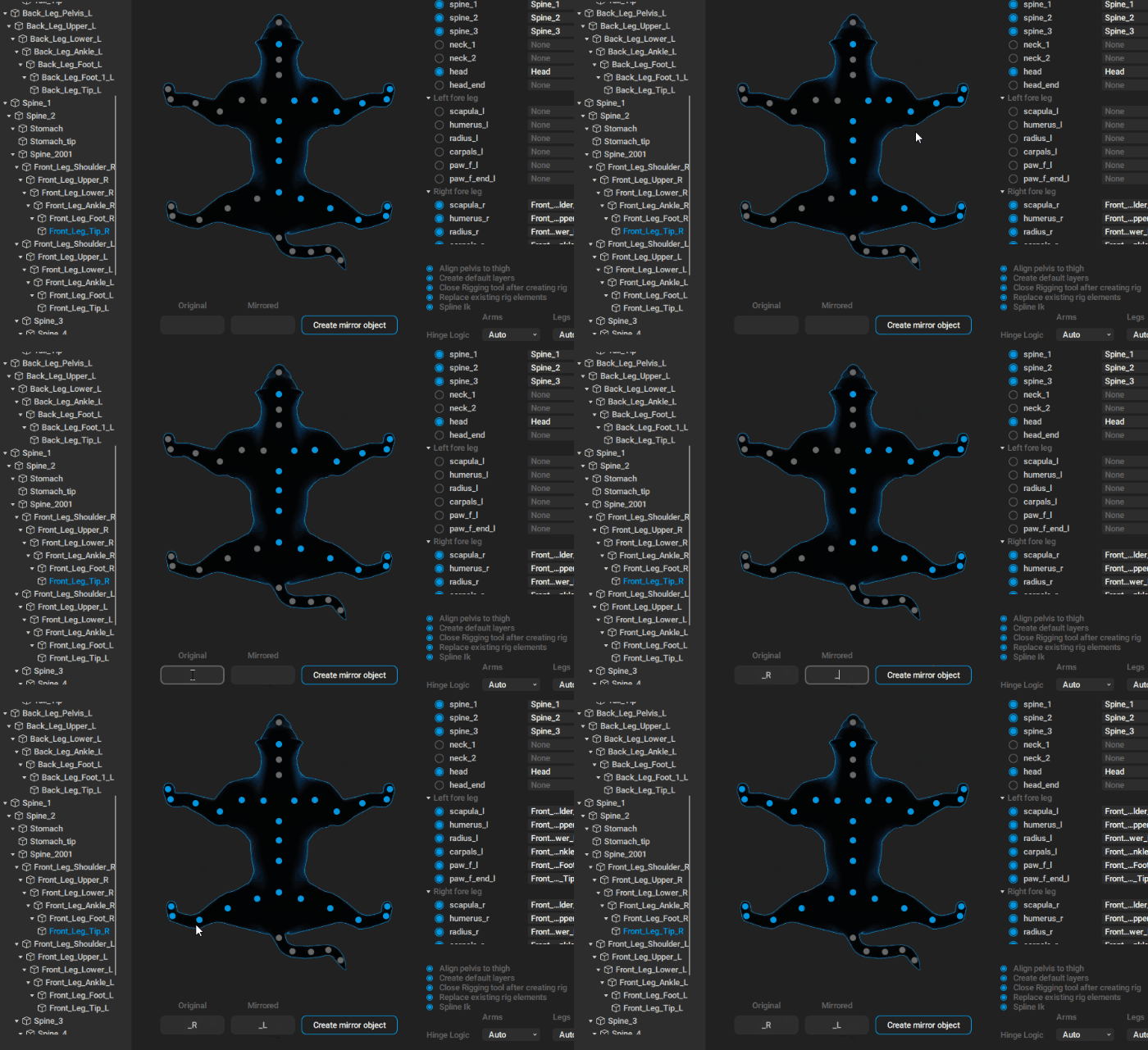
An example of using Mirror to duplicate the rig elements.
See here to learn more about it.
Adjustments & Final Touches
Quadruped characters often have secondary details such as ears and jaws.
You can rig them using only Box Controllers.
And if such body part - like an ear, for example, - has several joints in it, it might be a good idea to create boxes for all of them so you’ll be able to control it more precisely.
See the Secondary Elements page to learn more about working with such details.
When Point Controllers are positioned too close together, they become difficult to manipulate; so you can adjust their positions to place them more apart
You can also change sizes and positions of the Box Controllers - this won’t change how they affect the rig, but will make them easier to work with.
You can adjust the position of the Center of Mass by changing the masses of the Rigid Bodies; in animals specifically, the Center of Mass is often located closer to the shoulderblades than it is to the center of the body.
Aside from the mass, you can also adjust the size of a Rigid Body individually along all three axes. A good practice is to adjust them so the rigid bodies would roughly align with the surface of the mesh - though this is not a strict rule, and it is not always achievable.
You can also adjust the collision shapes attached to the Rigid Bodies - alos to align them with the mesh surface.
Parameters for collision shapes can be found in the Capsule collision on the Object Properties panel.
Finalizing the Rig
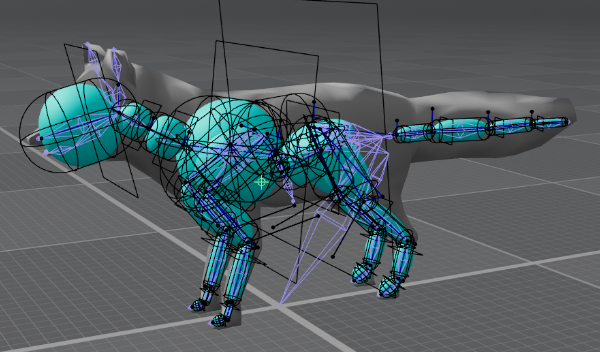
Once you done with the adjustments, you should have something like this:
Now you can click the Generate button:
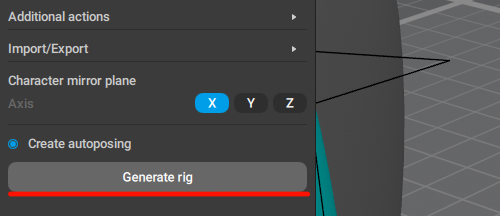
And wait a bit as the rig is finalized.
Non-Quadrupeds
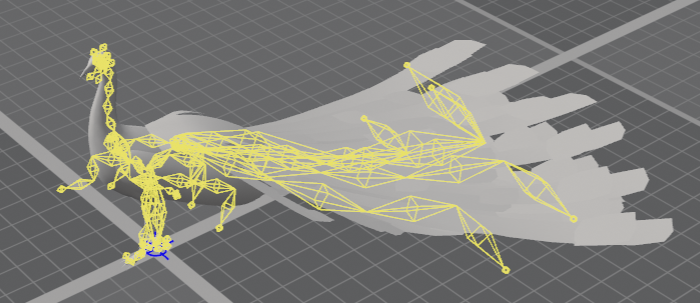
You might also encounter characters with skeletons that do not follow the standard quadruped structure.
For convenience, you can still use Quick Rigging Tool to rig parts of such models. For the example above, these would be the spine, the neck and the legs.
Other parts have to be rigged manually.
But the principle remains the same: Joints form chains, and your task is to rig these chains, one at a time.
Start with finding the top Joint in the chain: the one that the chain starts with.
See also How to Find the First Joint to learn more about this topic.
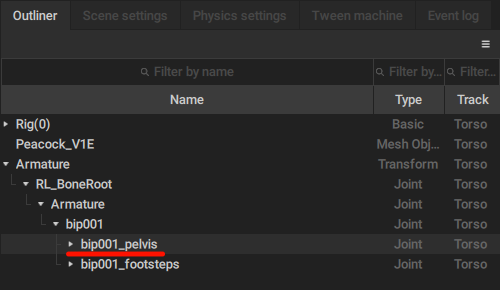
In this model, for example, it is called bip001_pelvis.
After finding the first joint, we should move ‘down’ in the hierarchy.
Most of the characters have some kind of body: a 'main' part of their structure to which other body parts are attached.
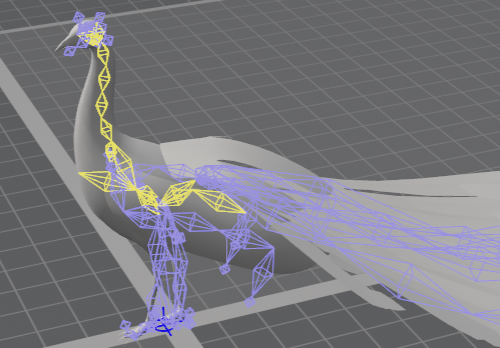
The model with the spine joints selected.
But even if they don’t, the process is the same.
Your task is to find the joints associated with the chain, and create Rig Elements for them.
How many elements you need to create depends on how elastic you want the chain to be. If your character is flexible, you’ll probably need a separate set of elements for every Joint.
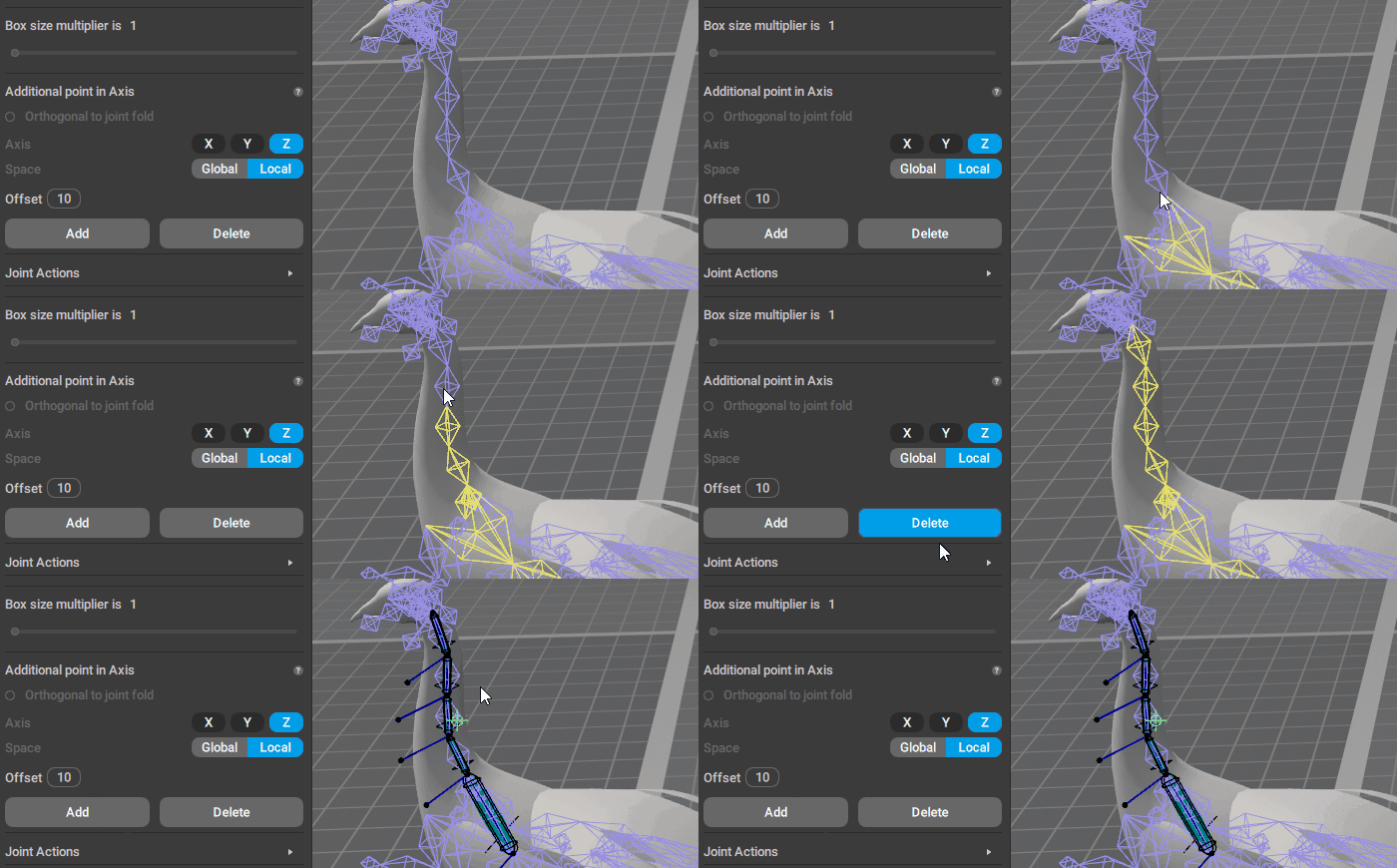
To make the rig simple - and easier to control - you may reduce the number of rig elements by creating one element for several joints.
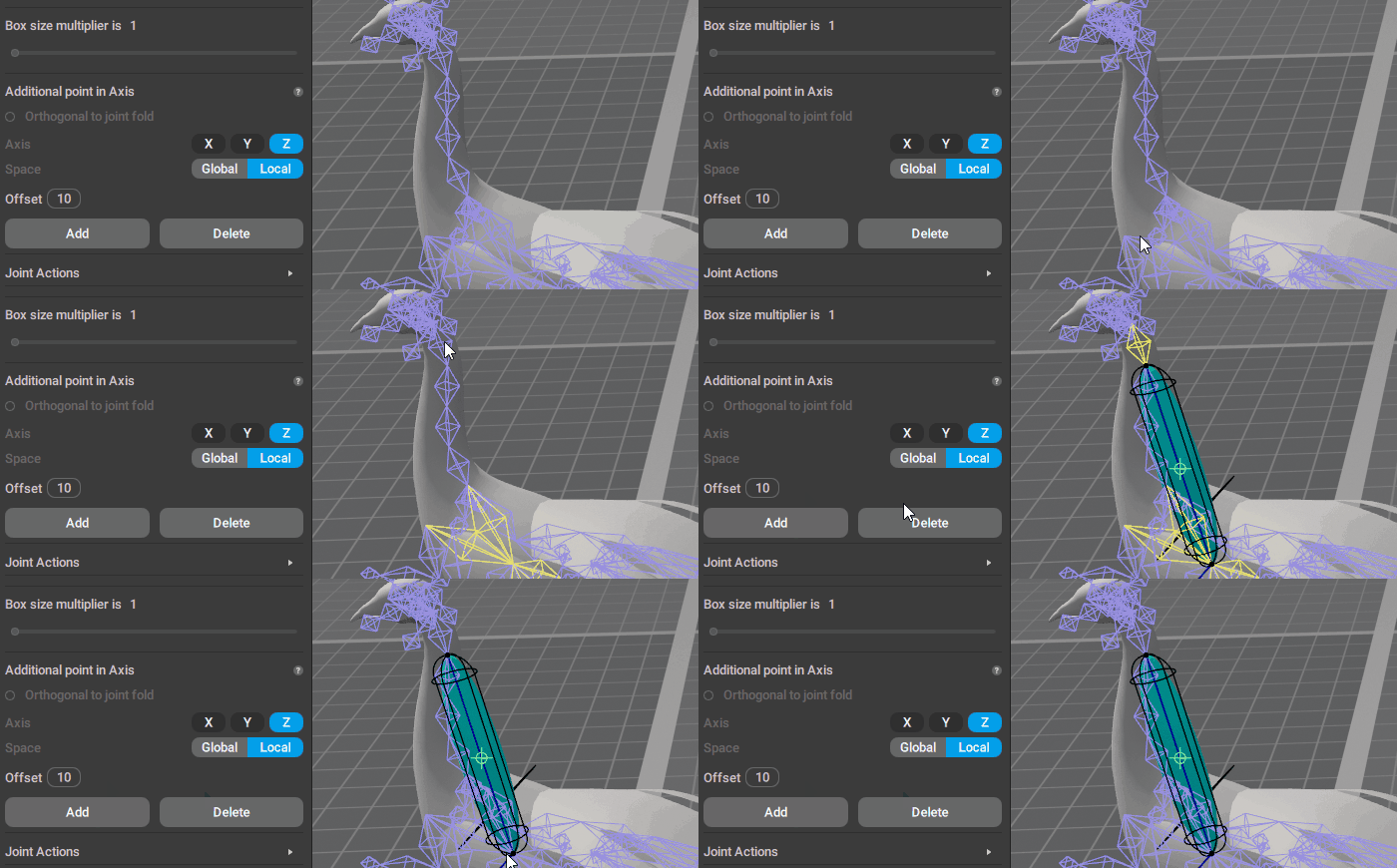
See also: Rigging Complex Skeletons.
Limbs
Animated characters often display some level of symmetry, and most often - with limbs.
This means we can use the Mirroring and only rig one side of the character.
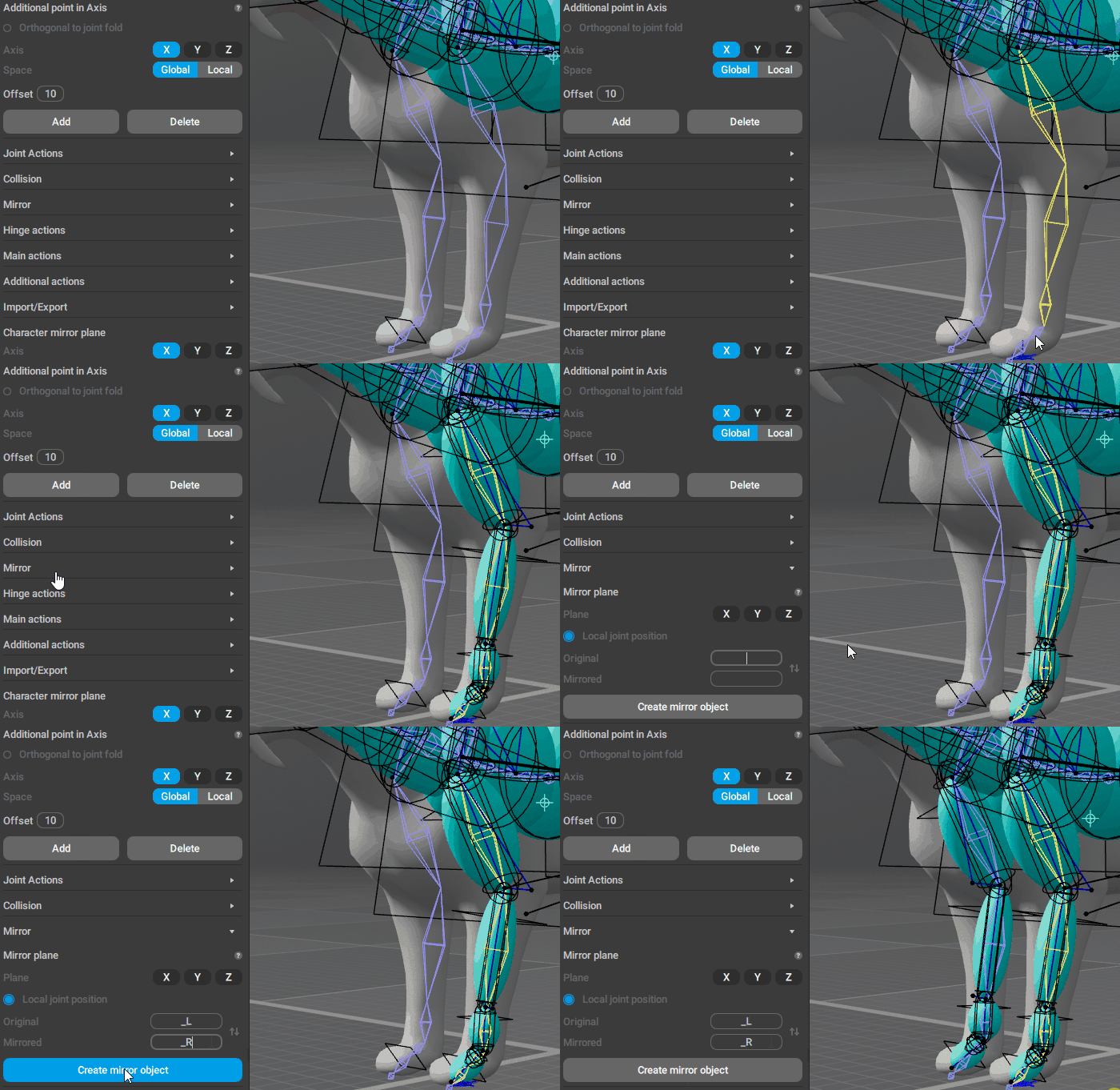
See the Mirroring page to learn about this.
And when the character’s limbs are not symmetrical (like one arm being bigger than the other), they can be rigged manually just as well.