Live Link for Unreal Engine
- Home
- Tools
- Animation Tools
- Live Link for Unreal Engine

This feature allows Cascadeur to stream animation data to Unreal Engine via Live Link, a data streaming interface.
Warning
This is a paid feature that’s available in the Indie, Pro and Teams subscriptions.
It's also only available in the Windows build of Cascadeur.
How Live Link Works
Live Link takes the joints/bones found in your Cascadeur scene and streams their animated transforms - position, rotation and scale - to Unreal Engine. After the animation data is received, it is applied to the name-matched joints.
You can learn more from Epic Games’ official documentation.
Installation
To use Live Link with Cascadeur, you must install the “Cascadeur Live Link” plugin in Unreal Engine.
Warning
Cascadeur Live Link plugin can only be used with Unreal 5.5-5.8 and Cascadeur 2026.1 or later.
Older versions of Unreal can’t use the plugin. Older versions of Cascadeur (2024.3 to 2025.3) have limited LiveLink functionality, but can stream without the plugin.
Installation Through FAB
1. Enter the FAB marketplace.
2. Search for Cascadeur Live Link.
3. Add the plugin to your Engine.
4. In your launched Unreal project, go to Edit -> Plugins.
5. Search for the Cascadeur Live Link plugin and activate it.
6. Restart Unreal.
After the plugin is activated in Unreal Engine, you’ll be able to connect Cascadeur and Unreal through Live Link.
Model Requirements
Note
The most straightforward approach to meeting the model requirements in Cascadeur would be to use the character model exported from Unreal Engine, since it should have maximum compatibility with the Unreal Engine from the start.
Alternatively, you can use one of the sample Cascadeur scenes with pre-rigged character models.
To facilitate smooth data transfer between the apps, the models and scenes in Cascadeur and Unreal must meet specific requirements:
1. Joint names and skeleton hierarchies must be identical
Live Link works by applying the streamed animated transforms from Cascadeur to the name-matched joints in the chosen skeleton mesh inside Unreal Engine.
Incorrect name-matching will prevent joints in Unreal Engine from being recognised, leading to incorrect movement.
Hierarchy differences may lead to unexpected rotational offsets in some joints, resulting in an incorrect pose.
Note that only the base skeleton’s joint names and hierarchy must be identical; any auxiliary joints that are not inserted between the base skeleton joints will be ignored.
For example, If you stream Cascadeur’s “UE5 Manny” sample scene to Unreal, all four of its skeleton mesh variants - Manny, Quinn and two Simple versions - will be able to receive the streamed data from it, since they all have the same base skeleton.
2. Root joint/object in the Cascadeur scene must have its rotation orientation matched to Unreal’s.
Unreal Engine and Cascadeur have different scene orientations, with different Forward and Up Axis.
Cascadeur has +Z as Forward Axis and +Y as Up Axis.
Unreal Engine has +Y as Forward Axis and +Z as Up Axis.
To match the root joint/object’s orientation in Cascadeur to Unreal’s, its Local Rotation must be set to -90/0/0.
Note
Character models exported from Unreal Engine always include a “scene space” root object with the skeleton hierarchy parented to it, which should already have the correct orientation.
3. Root joint/object must have the scale set to 1/1/1 in Cascadeur and Unreal
Game engines prefer the model’s base scale to be set to 1/1/1. If the scales don’t match between the software, the overall size and proportions of the character model will differ.
It’s recommended to check and apply the correct scale before you import the character model you’re working with to Unreal Engine and Cascadeur.
Note
Character models exported from Blender may have their 100x scale applied on import in Unreal. Streaming data with Live Link to such a model will cause the joints to stretch.
To check for the hidden applied scale, add a socket to one of the end bones in Unreal and render any mesh in it - if it appears too large, the original model that you’ve imported into Unreal might have had a larger scale.
Enabling LiveLink
Warning
The Live Link functionality has changed considerably after version 2026.1. Follow the instructions below for the version of Cascadeur installed on your device.
You can check your installed version of Cascadeur at Help -> About -> Cascadeur.
To set up Live Link, follow these steps:
1. Launch Unreal Engine and open your target project.
Cascadeur 2026.1 and later:
Make sure the Cascadeur Live Link plugin is installed, then continue.
Cascadeur 2024.3 to 2025.3:
Continue to the next step.
2. Launch Cascadeur and open a scene with your target character model.
Note
Ensure the character models in both scenes adhere to the Model requirements highlighted earlier.
3. Select Live Link from the Synchronization menu:
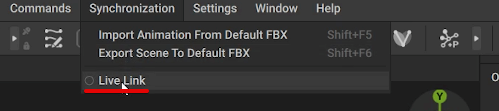
Cascadeur 2026.1 and later:
A 'Waiting for connection' notification message will appear, indicating that Cascadeur is awaiting a connection to Unreal Engine. Continue to the next step.
Cascadeur 2024.3 to 2025.3:
The Live Link connection on Cascadeur’s side is now active. Continue to the next step.
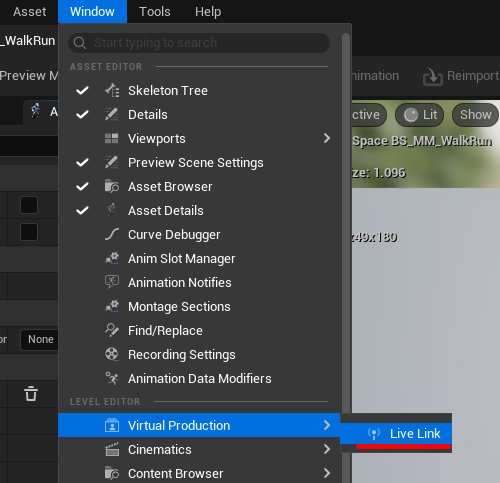
4. Select Virtual Production → Live Link from the Window menu:
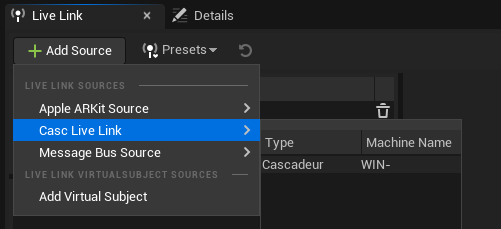
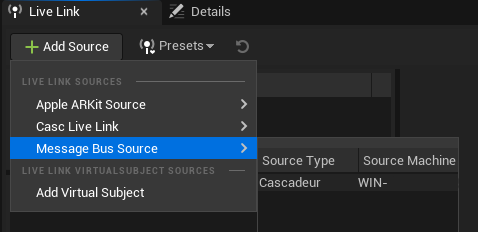
5. Connect the Source to Unreal Engine in the appeared Live Link window.
Cascadeur 2026.1 and later:
Click Add Source → Casc Live Link → Cascadeur:
Cascadeur 2024.3 to 2025.3:
Click Add Source → Message Bus Source → Cascadeur:
Streaming Animated Data
Note
This section details how to stream animation data via Live Link in Cascadeur 2026.1 or later.
Unreal Engine Link window’s contents
After you’ve connected Cascadeur and Unreal Engine via Live Link, a new window will appear in Cascadeur:
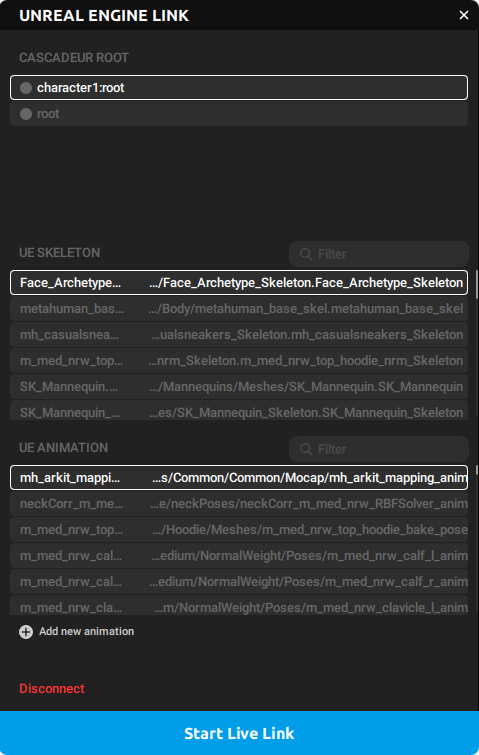
Let’s take a look at the four different parts of it, from top to bottom:
1. Cascadeur Root
A list of root joints found in the current scene.
Each root represents a separate skeleton hierarchy in your currently opened Cascadeur scene, which can be streamed to Unreal.
2. UE Skeleton
A list of skeleton assets found in your Unreal Engine project.
You can scroll through the list or use the "Filter" search field to find the right skeleton.
The streamed animation data will be name-matched and applied to the selected skeleton.
3. UE Animation
A list of Animation Sequence assets found in your Unreal Engine project.
You can scroll through the list or use the “Filter” search field to find the right skeleton.
There’s also the Add new animation button, which you can use to add a new named Animation Sequence in your linked Unreal project.
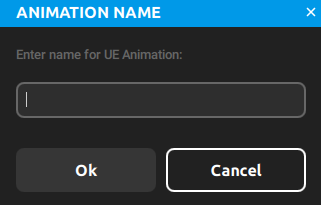
The streamed animation data will be recorded into the selected animation sequence.
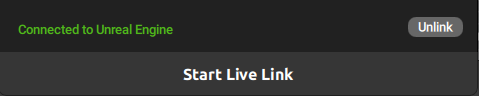
4. Start Live Link
The button that connects your running Unreal project to Cascadeur. Connection status is showcased to the left, with either Disconnected or Connected to Unreal Engine.
There’s also an Unlink button that appears when Cascadeur is connected to Unreal, which can be used to sever the connection.
Connecting Cascadeur to Unreal Engine
To apply the streamed animation data in Unreal, you’ll have to interact with the Unreal Engine Link window:
1. In the Cascadeur Root section, select the root object belonging to the target model that you want to stream the animation data from.
Note
If you want to connect multiple characters from one scene, steps 1 to 4 would have to be done again for the other characters’ root objects, too.
2. In the UE Skeleton section, find and select the skeleton compatible with your target Cascadeur model.
3. In the UE Animation section, find and select the animation sequence to write the streamed animation data into.
If you want, you can create a new animation sequence with the “Add new animation” button.
4. Click the Start Live Link button
After a successful connection, the Unreal Engine icon will appear in the LiveLink-connected scene tab.
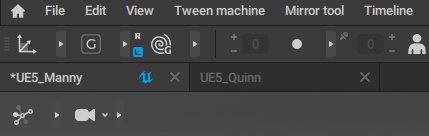
Additionally, the notification Live UE link will appear in the top right corner of the Cascadeur window:
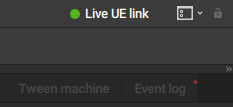
At this point, you can close the Unreal Engine Link window. If you’d need to open it again later, you can bring it up via the same Synchronization menu in Cascadeur.
Applying Streamed Data in Unreal
Similar to the Maya-Unreal Bridge plugin, the streamed animation data from Cascadeur is played in Sequencer by applying the sequence to the target skeleton mesh.
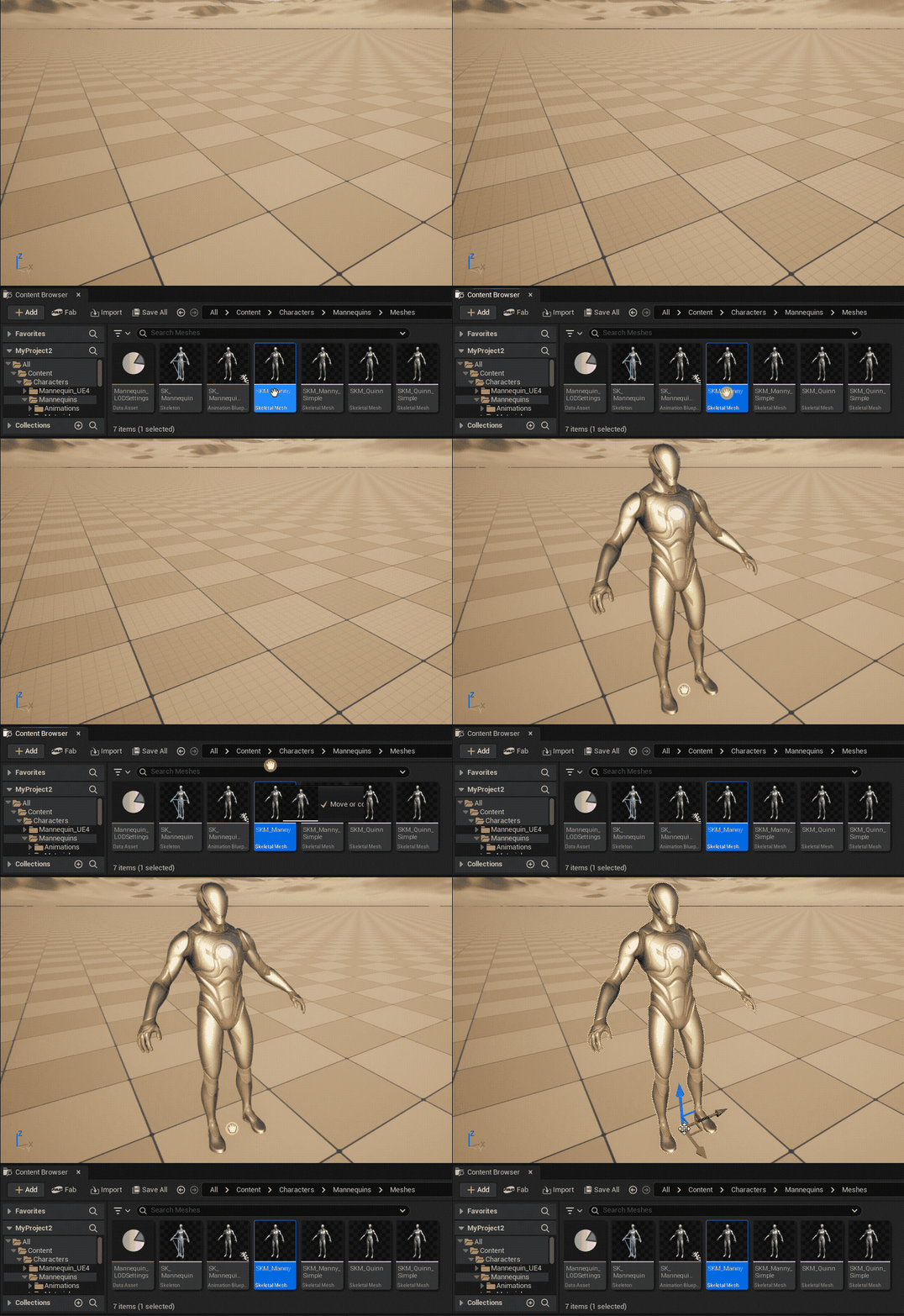
1. Put the target skeleton mesh into the level:
2. Create a new Level Sequence via Add → Cinematics → Level Sequence and open it.
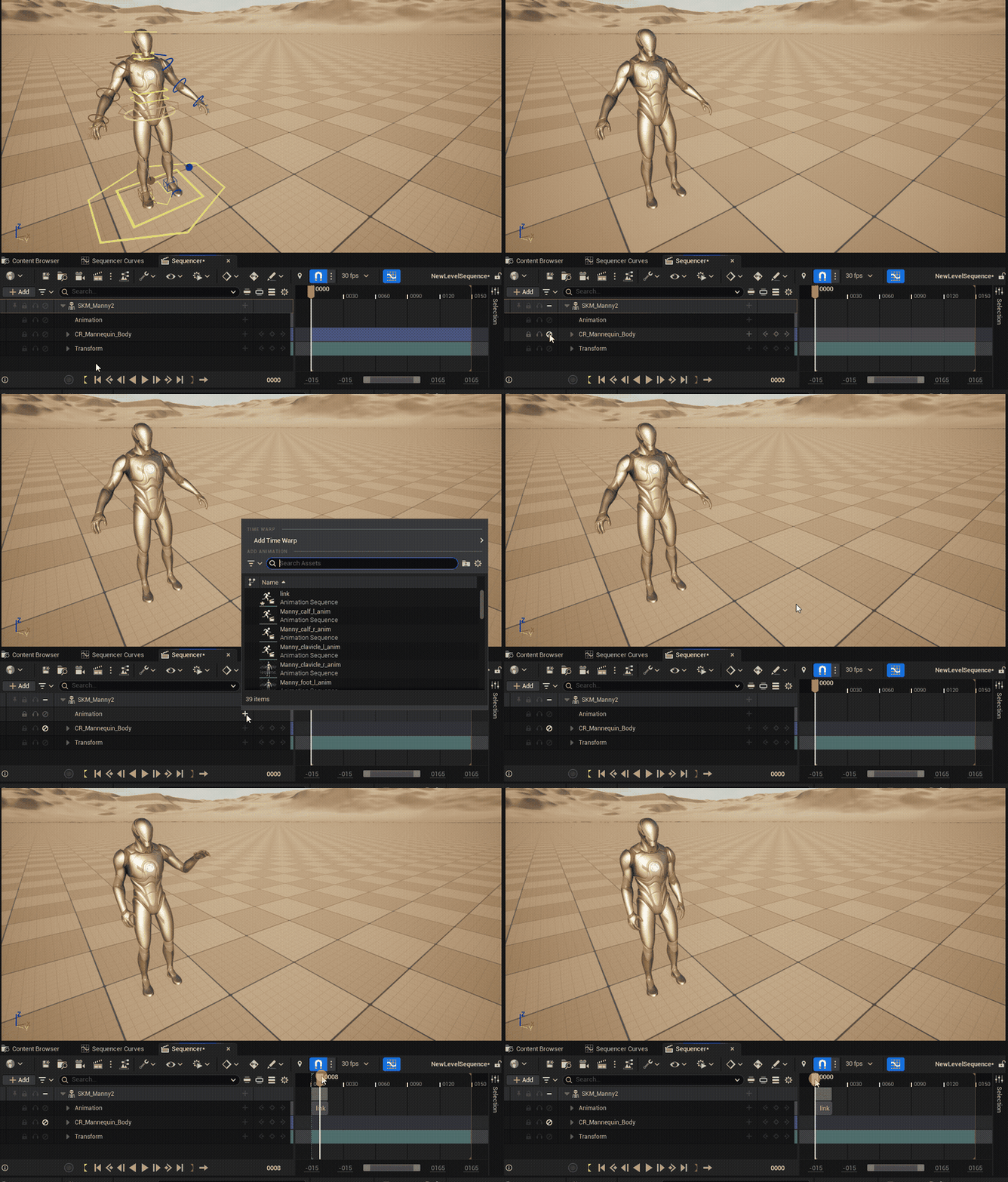
3. While in Sequencer, select your target skeleton mesh and then add it to the currently opened Level Sequence via Add → Actor to Sequencer → Add ‘ActorName’.
4. Apply the UE Animation you’ve selected in the Unreal Engine Link window to your target character.
Note
If Unreal auto-generated the Control Rig for your character model, disable it before applying the animation.
Streaming Animated Data (older versions)
This section details how to stream animation data via Live Link in Cascadeur 2024.3 to 2025.3.
Warning
Only one character model from a single scene can be streamed into Unreal using this method.
Applying Streamed Data in Unreal
To see the streamed animation data in Unreal, we’ll have to pass the Live Link data into the character’s Animation Blueprint.
1. Create or access the target character model’s Animation Blueprint.
2. Right-Click the Blueprint space, then add the Live Link Pose action.
3. Select the corresponding 'subject name', then connect the action to the Output Pose.
4. Compile the Animation Blueprint.
To see the streamed animation data in your level on your target actor, you’ll have to apply the Animation Blueprint to the actor.
1. Select the target character actor in your level
2. Apply the Animation Blueprint in the Details tab:
Animation Mode → Use Animation Blueprint
Anim Class → “Your Animation Blueprint”
3. To see the pose change in the Editor, turn on the setting at:
Details → Animation → Skeletal Mesh → Update animation in Editor
Common Issues
1) The applied animation in the Sequencer isn’t being updated after connecting the LiveLink
There are multiple possible solutions to this:
1. Close and open the Sequencer to update its contents.
2. Restart Live Link in Cascadeur.
3. Create a new Animation Sequence through Cascadeur Live Link and make sure that there are 2 or more keyframes in your Cascadeur scene.
2) Problems with connecting the Live Link between the software
1. Launch Cascadeur and Unreal in administrator mode
2. Make sure that Cascadeur and Unreal aren’t being blocked in your firewall settings
3) It’s very difficult to align paired animations on the sample UE characters (Manny, Quinn) in Cascadeur
1. Turn off the Root constraint for each rig in Cascadeur:
Outliner window → Rig(0) → Root Constraints → root_constraint
Then, in the Object properties window, select the Constraint behavior and turn off the “Constraint active” bool.
2. Reset each character’s Global Position on the root joint, on each frame throughout the whole animation:
Select the root joint and the whole animated timeline, turn on “Apply on selected interval” and zero out the Global Position in the root joint’s Transform behavior.
Additional Notes About Cascadeur Live Link
1. Live Link plugin can stream animation data from Cascadeur to Unreal, but not the other way around.
2. Moving the current frame indicator on the Cascadeur timeline moves the current frame indicator in the opened Sequencer in Unreal. This doesn’t work the other way around, and in other windows.
In older versions, moving the current frame indicator updates the pose being streamed to Unreal.
3. You can open and preview the Animation Sequence used to stream data from Cascadeur. While you’re editing the animation in Cascadeur, the animation length and poses on each frame are updated.
4. Casc Live Link Preview Controller will not update the current pose in the preview window.
5. It’s technically possible to retarget the streamed animation from your target model to another model with a non-compatible skeleton using the IK Retargeter in Unreal.