
Cascadeur 2026.1 is now available in our download section, introducing one of the biggest workflow and technology upgrades in recent versions. With this release, Cascadeur fully transitions to the Filament Rendering Engine, adds a long-awaited Unreal Engine Live Link, and introduces a new AI-powered Root Motion Tool for generating and transferring motion signatures.
Alongside these major additions, version 2026.1 also brings a set of practical workflow improvements, including Collision Penetration Cleaning, Constraints in AutoPhysics, and more natural AutoPosing for quadruped characters.
Our highlights video walks you through the main new features in Cascadeur 2026.1 and shows how they work in practice:
What’s new in Cascadeur 2026.1?
Unreal Engine Live Link
The new Unreal Engine Live Link allows you to stream animation directly from Cascadeur into Unreal Engine in real time. This makes it much easier to preview motion inside a UE scene, evaluate timing and staging in context, and iterate faster without repeated manual export steps.
The feature was developed with the support of an Epic MegaGrant and marks an important step in improving Cascadeur’s workflow for game developers, technical artists, and animation teams working inside Unreal Engine pipelines.
Important note: the Unreal Engine Live Link plugin is currently available as a separate manual download and installation via the dedicated Live Link documentation page. It will be published on the FAB marketplace at a later date.
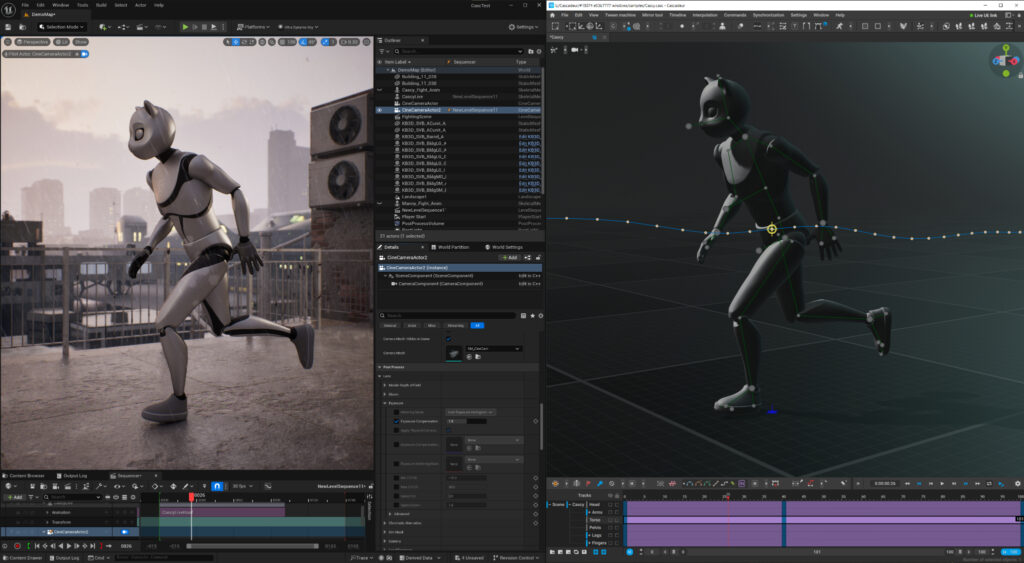
Filament Rendering Engine
With version 2026.1, Cascadeur has now fully migrated to the Filament Rendering Engine. What was previously available as an experimental preview in 2025.3 is now fully integrated into the main release. This brings a substantial improvement in viewport quality and gives users a much more advanced visual environment while animating.
Lighting, shading, materials, and overall scene readability are now significantly improved, helping animators and technical artists judge poses, silhouettes, and motion more comfortably inside the viewport.
Root Motion Tool
The new Root Motion Tool introduces a new AI-assisted approach to motion style transfer. Using a diffusion model, the tool can analyze motion signatures from reference animation and apply their movement character to new animation clips.
This opens up new possibilities for experimenting with style, preserving the feel of specific body mechanics, and generating root motion patterns that better match the intended character performance. It is a powerful addition for users who want to explore not just what a character does, but how that motion feels.
Collision Penetration Cleaning
Complex character animation often leads to unwanted body intersections or floor penetrations that require manual cleanup. The new Collision Penetration Cleaning tool is designed to make this process much easier.
It helps detect and resolve problematic intersections more efficiently, reducing cleanup time and making it easier to polish animation scenes without breaking the original motion more than necessary.
Constraints in AutoPhysics
Point constraints are now integrated into Cascadeur’s physics engine. This means that objects such as weapons, props, or tools can stay locked to a character’s hand during AutoPhysics and Ragdoll simulations.
This improvement makes physically assisted animation workflows more reliable in situations where specific object relationships must remain stable throughout the simulation.
Enhanced Quadruped AutoPosing
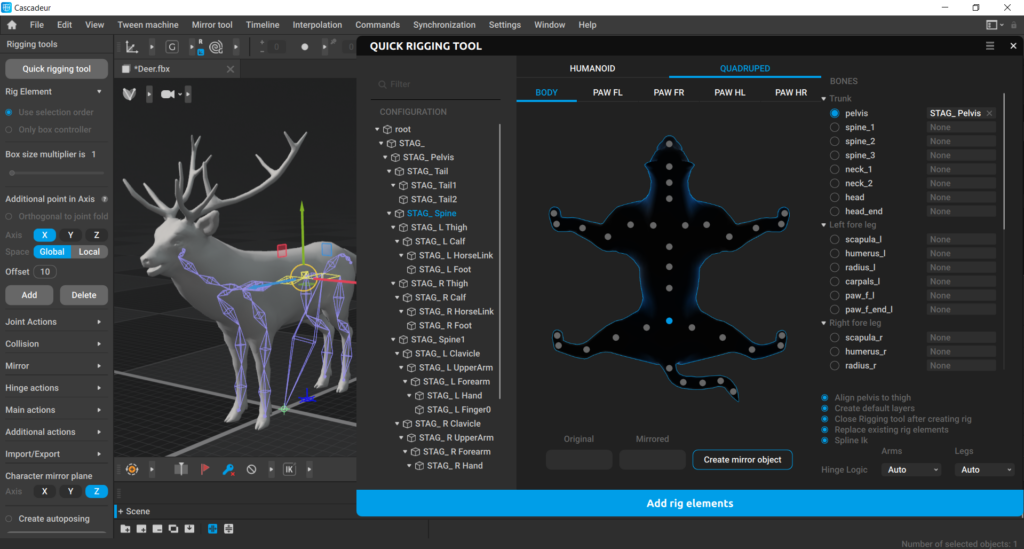
Quadruped support introduced in earlier versions has now been improved further. In Cascadeur 2026.1, AutoPosing for four-legged characters feels more natural, more intuitive, and better adapted to creatures such as cats, horses, and similar rigs.
This makes the feature more practical for a wider range of animal animation tasks and improves the overall posing experience for non-biped characters.
For a complete list of changes, check out the full release notes.


